
Zenergize, the Made-in-India solar inverter and EV charger company, recently announced a target of 10,000 customers in Hyderabad by end of 2026 as covered by Deccan Chronicle. The move reflects something the numbers have been signalling for a while: Hyderabad is becoming one of India’s most important rooftop solar markets, and most consumers in the city are only beginning to realise it.
Here is what you actually need to know before making a decision.
Is Hyderabad a good city for rooftop solar?
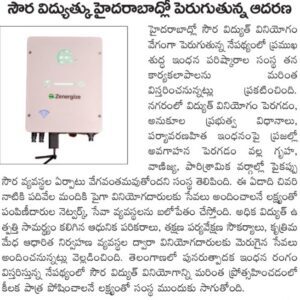
Yes. Hyderabad receives more than 300 sunny days per year and sits within one of the highest solar irradiation bands in the country. In practical terms, a well-installed system with the right inverter can generate more usable electricity per panel here than in most other Indian cities. Zenergize installations across Hyderabad have recorded up to 24 units of generation in a single day – a figure that reflects both the city’s solar resource and the efficiency of SiC-based inverter technology in high-temperature conditions.
India as a whole crossed 27.88 GW of rooftop solar installations by March 2026. Telangana had installed approximately 473 MW of rooftop solar capacity as of early 2025 making it the fourth largest rooftop solar state in southern India. City-level data isn’t published separately, but Hyderabad, as Telangana’s commercial and population centre, accounts for the bulk of that installed base. Zenergize now ranks the city among its top five markets nationally.
What has changed with Telangana’s net metering policy?
Telangana has expanded both its net metering and virtual net metering provisions, making the financial case for solar significantly stronger for residential, commercial, and institutional consumers.
Under net metering, surplus electricity your solar system generates is fed back to the grid and credited against your bill. Virtual net metering extends this to multi-tenant properties like apartment complexes and commercial parks, where a single rooftop installation can benefit multiple consumers. The state’s electricity regulator allows net metering for systems from 1 kW up to 1,000 kW, with permission issued by TGSPDCL within 21 days of application.
For homeowners and housing societies, this changes the investment conversation. You are not just offsetting your consumption, you are earning against it.
Why does the inverter matter more in Hyderabad than other cities?
Because Hyderabad’s summers are harsh, and most inverters were not designed with that in mind.
Ambient temperatures in the city regularly reach 42 to 45 degrees Celsius during peak summer. Conventional inverters use IGBT-based components that throttle their own output under sustained heat – a process called thermal derating to prevent damage. The result: the inverter produces less electricity on the very days your panels are generating the most.
Zenergize’s grid-tied solar inverters use Silicon Carbide (SiC) semiconductor technology, developed in partnership with Infineon Technologies. SiC components operate at higher junction temperatures without derating, which translates directly into more usable generation across the long Hyderabad summer. The company reports up to 25% higher energy generation compared to conventional alternatives in real-world Indian installations.
This is not a marginal difference. Across a 25-year system lifespan, it compounds significantly.
How do I know if my solar system is actually performing?
This is the question most buyers do not think to ask until something goes wrong.
A solar system that looks fine from the outside can be underperforming for months – inverter inefficiency, panel soiling, grid instability – and you only discover it when you compare your bill to what you expected. By then, you have lost generation you cannot recover.
ZenSense, Zenergize’s intelligent monitoring platform, addresses this directly. It tracks real-time power generation, simulates inverter behaviour to predict failures before they happen, sends proactive alerts for power cuts and surge events, and provides cleaning schedule recommendations based on actual performance data. Everything is accessible through a mobile app.
It is also the only platform in India that monitors both solar inverters and EV chargers under one interface, relevant for homes and businesses that are electrifying across both energy and mobility simultaneously.
What does after-sales service look like for solar in Hyderabad?
After-sales support is the most common complaint in the Indian solar industry, and for good reason. Many installers and even some large brands disappear once the installation is done.
Zenergize has invested specifically in Hyderabad’s service infrastructure, with trained professionals offering installation support, maintenance, and troubleshooting across the city. The company operates a PAN-India service network with presence in over 40 cities, backed by locally stocked spare parts to reduce repair turnaround times.
Warranty coverage is also a signal worth paying attention to when comparing options. Zenergize offers what it describes as the industry’s longest warranty on its inverters of 10 years – a commitment that only makes commercial sense if the hardware is built to last.
For more on what to look for when evaluating service commitments, see Zenergize’s full product overview.
What does Zenergize’s CEO say about solar growth in Hyderabad?
Navneet Daga, Co-founder and CEO of Zenergize, frames it as a question of intent, not just conditions.
“Hyderabad represents a significant growth opportunity for us, not only because of its favourable solar conditions but also due to the increasing willingness among consumers and businesses to invest in long-term energy independence.” (Source: Deccan Chronicle)
That shift in consumer intent is something the team is seeing across every segment. As Daga put it in the same interaction: “Customers today are looking beyond installation. They want higher energy generation, reliable performance, transparency into system health, and dependable service support. Our focus is to deliver a complete solar ownership experience that helps them maximise returns from every unit of solar energy generated.”
Both quotes reflect where the market is heading: away from a transactional “install and forget” mindset, toward something closer to an energy infrastructure decision.
Is this the right time to invest in rooftop solar in Hyderabad?
For most homeowners and businesses, yes and the reasons are structural, not promotional.
Electricity costs are rising steadily. Grid demand is increasing faster than supply in high-growth urban corridors. Telangana’s policy environment is genuinely supportive right now, and net metering credits make the payback timeline more predictable than it has ever been. The technology itself, particularly SiC-based inverters, has matured to a point where long-term reliability is no longer a gamble.
The consumers who install in the next 12 to 18 months will have the longest period of bill savings before the market becomes crowded, prices normalise, and subsidies potentially shift. That window is open, but it is not permanent.
Frequently Asked Questions
How many units of electricity can a solar system generate in Hyderabad per day?
Output depends on system size and inverter efficiency, but Zenergize installations in Hyderabad have recorded up to 24 units per day. Hyderabad’s irradiation levels and 300+ sunny days per year put it among the most productive urban solar markets in India.
What is the minimum system size for net metering in Telangana?
The minimum is 1 kW. Single-phase consumers can apply for net metering for systems up to 5 kW. TGSPDCL is required to issue permission within 21 days of a complete application.
Which solar inverter technology works best in Hyderabad’s heat?
Silicon Carbide (SiC) inverters handle high ambient temperatures significantly better than conventional IGBT-based inverters, which throttle output under heat. For Hyderabad’s summers, SiC technology means more generation on the days that count most.
Does Zenergize service solar systems in Hyderabad?
Yes. Zenergize has a dedicated service network in Hyderabad with trained professionals for installation, maintenance, and troubleshooting. Spare parts are locally stocked to minimise downtime.
Can I monitor my solar system remotely?
Yes, through ZenSense – Zenergize’s monitoring platform, which tracks real-time generation, predicts failures, and sends alerts via mobile app.
Is Zenergize’s solar inverter manufactured in India?
Yes. Zenergize designs and manufactures its solar inverters in India, with approximately 60% localisation in components. The company has an in-house R&D and manufacturing facility in Parwanoo and has partnered with Infineon Technologies for SiC semiconductor components. Read more about the company’s localisation commitments: Zenergize DC Fast Charger Localisation.
Ready to explore solar for your home, society, or business in Hyderabad? Talk to the Zenergize team – we will assess your site, estimate generation potential, and walk you through installation, monitoring, and service coverage.
