India is adding EV charging stations at a fast pace. But are those chargers actually built to survive an Indian summer? Navneet Daga, Co-founder and CEO of Zenergize, recently sat…
India is adding EV charging stations at a fast pace. But are those chargers actually built to survive an Indian summer?
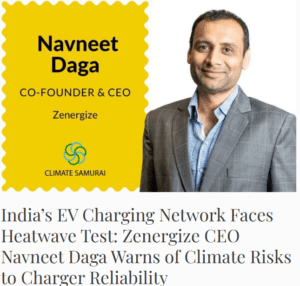
Navneet Daga, Co-founder and CEO of Zenergize, recently sat down with Climate Samurai to talk about a problem that does not get enough attention: most EV chargers in India were not designed for the extreme heat that large parts of the country regularly see.
When temperatures cross 45°C, conventional chargers start slowing down automatically to avoid overheating. Many stop working altogether. For EV drivers, this means pulling up to a charging station and finding it either slow or completely non-functional, which is a frustrating and trust-breaking experience.
Navneet points out that the early push to roll out charging infrastructure focused heavily on numbers. How many stations, how fast. The quality, durability, and suitability for Indian weather conditions were not always prioritised. The result is visible today in the number of charging stations that are either underperforming or simply out of service.
At Zenergize, the team is working on chargers built around silicon carbide technology, which runs cooler, wastes less energy, and holds up far better in high-temperature environments. The company works with government bodies, charge point operators, and infrastructure developers to build EV charging and solar solutions designed specifically for Indian conditions.
On the policy side, Navneet believes current standards need to catch up. He is calling for proper heat performance testing before chargers get approved for deployment, and for accountability around uptime so that installed chargers are actually kept functional.
The broader message is straightforward: growing the number of chargers only solves part of the problem. If those chargers go down every summer, consumer trust in electric vehicles takes a hit and that slows the entire transition down.
📖 Read the full interview on Climate Samurai: India’s EV Charging Network Faces Heatwave Test
Originally published at https://www.zenergize.in/zenergize-ceo-navneet-daga-ev-charging-heatwave-india/
Written by

Navneet Daga
Co-Founder & CEO at Zenergize. IIT alumni. 16+ years of experience with Accenture, Delhivery, SuperPlum etc. Building India’s first indigenous SiC solar inverter.
View LinkedIn