It’s peak summer. The sun is blazing. Your rooftop solar array is generating maximum power. Your AC is running at full load. And your inverter is silently doing something most…
It’s peak summer. The sun is blazing. Your rooftop solar array is generating maximum power. Your AC is running at full load. And your inverter is silently doing something most people do not know about: it is throttling itself.
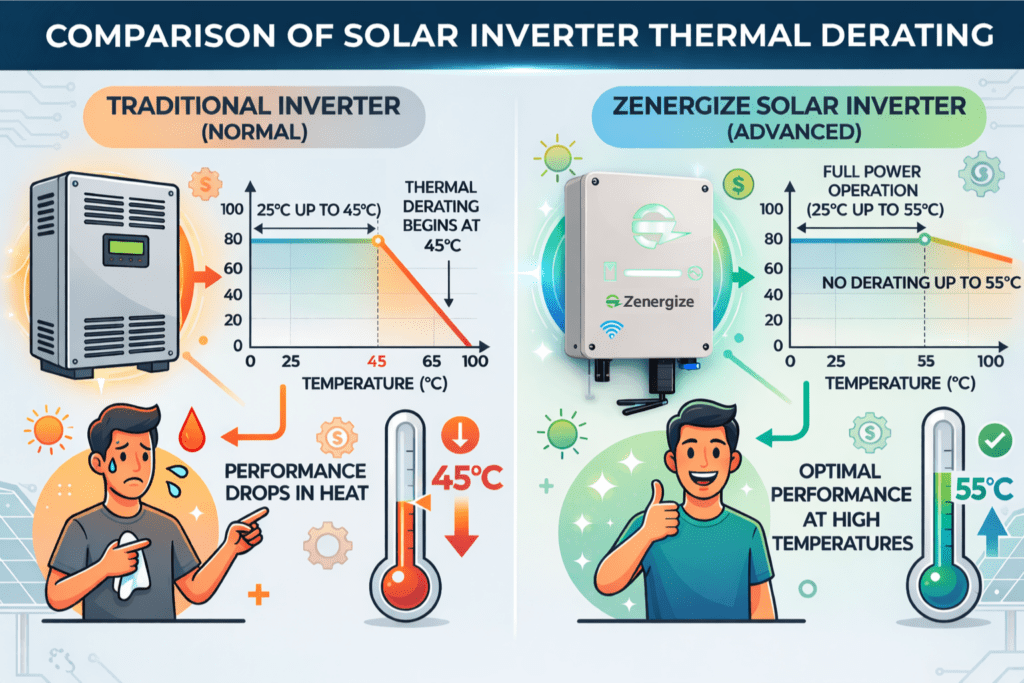
This is called temperature derating, and it is one of the most under-discussed performance problems in the Indian solar and power electronics market.
India’s summers are brutal for electronics. Ambient rooftop temperatures in cities like Nagpur, Jaisalmer, Delhi, and Ahmedabad routinely hit 45–50°C in May and June. Rooftop surfaces themselves can reach 60–70°C due to direct solar radiation. When you place an inverter in or near such environments, the inverter cannot operate at its full load capacity.
What Is Derating, and Why Should You Care?
Derating is the mechanism responsible for this behavior. As the internal temperature of the inverter approaches its thermal limits (often beginning around 45 °C ambient), the inverter’s internal control system automatically compels it to operate at a lower output once temperatures rise beyond safe operating conditions.. This reduction is not optional; it is a built-in protection response designed to prevent overheating and damage to semiconductor devices.
Much like a smartphone that throttles its processor when it overheats to avoid shutdown, an inverter reduces its output when internal temperatures rise. The difference is scale: instead of a device losing performance, the entire solar system is forced to deliver less power.
Thermal derating in silicon IGBT-based solar inverters significantly impacts power generation, with power output typically decreasing by 3% for every 1°C that the internal temperature rises above the optimal operating limit.
Originally published at https://www.zenergize.in/solar-inverter-temperature-derating-india-summers/
Written by

Navneet Daga
Co-Founder & CEO at Zenergize. IIT alumni. 16+ years of experience with Accenture, Delhivery, SuperPlum etc. Building India’s first indigenous SiC solar inverter.
View LinkedIn