
As solar adoption accelerates across India, one of the most consequential decisions for any prospective solar user is the choice of inverter type. On-grid, hybrid, and off-grid inverters each serve distinct purposes, and selecting the appropriate system determines both the performance and long-term value of a solar installation.
This guide provides a clear, technically grounded overview of all three inverter types to help homeowners, businesses, and institutions make an informed decision.
Understanding the Role of a Solar Inverter
Solar photovoltaic (PV) panels generate direct current (DC) electricity. However, virtually all residential and commercial electrical infrastructure in India operates on alternating current (AC) at 230V, 50Hz. The inverter is the critical interface between these two systems ,it converts DC power from the panels into AC power usable by the end consumer.
Beyond this fundamental conversion, inverters differ significantly in their architecture, grid interaction, storage capability, and suitability for different use cases.
On-Grid Inverter (Grid-Tie Inverter)
How It Works
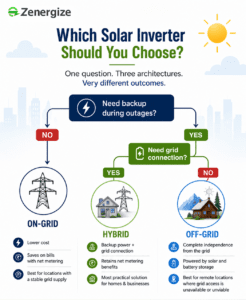
An on-grid inverter connects the solar PV system directly to the utility grid. Solar energy generated during daylight hours powers the connected loads. Any surplus generation beyond immediate consumption is exported to the grid. Under India’s net metering framework, consumers receive credits for this exported energy, which offset future electricity bills.
A defining characteristic of on-grid inverters is anti-islanding protection , a mandatory safety feature that automatically disconnects the inverter from the grid during a grid outage. This safeguard prevents backfeeding live current onto de-energised lines, protecting utility personnel engaged in repair or maintenance work.
As a result, on-grid systems do not provide backup power during outages. The system ceases to operate regardless of prevailing sunlight conditions.
Technical Overview: On-grid inverters employ Maximum Power Point Tracking (MPPT) algorithms that continuously monitor and adjust the operating voltage of the PV array to extract maximum available power under varying irradiance and temperature conditions. They must also maintain precise frequency and voltage synchronisation with the grid at all times.
Recommended For
- Locations with a stable and reliable grid supply
- Users whose primary objective is reducing electricity expenditure through net metering
- Installations where minimising capital expenditure is a priority
- Commercial and industrial consumers with consistent daytime power demand
Hybrid Inverter
How It Works
A hybrid inverter integrates the functionality of a grid-tie inverter with an integrated battery management system. It simultaneously manages three energy sources ,the solar PV array, the battery storage system, and the utility grid while continuously optimizing the flow of energy between them based on predefined logic and real-time conditions.
During normal operation, solar generation powers the load, charges the battery, and exports surplus to the grid, in a priority sequence configured by the user or installer. During a grid outage, the system seamlessly transitions to battery power, maintaining supply to critical loads without interruption. This transition, in modern hybrid inverters, occurs within milliseconds.
Technical Overview: Hybrid inverters incorporate bidirectional DC-DC converters that regulate battery charging and discharging, in addition to a grid-synchronised AC output stage and independent MPPT channels for the PV input. The control architecture must balance multiple simultaneous objectives like maximising self-consumption, maintaining battery state of charge within safe limits, and adhering to grid export regulations . This makes hybrid inverters the most technically sophisticated of the three categories.
Recommended For
- Households and businesses in urban and semi-urban India where grid outages are frequent or unpredictable
- Users seeking to maximise solar self-consumption while retaining grid connectivity
- Installations where energy resilience is as important as cost savings
- Commercial establishments with critical loads that cannot tolerate supply interruptions
Off-Grid Inverter
How It Works
An off-grid inverter operates entirely independent of the utility grid. The PV array charges a battery bank, and the inverter draws from this stored energy to supply AC power to the connected loads. There is no grid connection ,the system is entirely self-contained.
Because there is no grid as a reference or backup, system sizing becomes critical. The battery bank must be dimensioned to sustain the facility through periods of low solar generation like nights, extended cloud cover, and seasonal variation. Undersizing the battery bank results in supply shortfalls; oversizing results in unnecessary capital expenditure.
Technical Overview: Unlike grid-tie inverters, which synchronise their output frequency and voltage to an external grid reference, off-grid inverters generate their own AC output waveform independently, typically at a fixed 230V, 50Hz. This requires a more robust voltage and frequency regulation architecture. Many off-grid inverters also incorporate charge controllers to manage PV-to-battery charging, though in larger systems, standalone MPPT charge controllers are used.
Recommended For
- Remote and rural locations where grid infrastructure is unavailable or prohibitively expensive to access
- Agricultural, industrial, or institutional facilities in off-grid environments
- Telecom towers, border outposts, forest stations, and similar infrastructure in geographically isolated areas
- Users who require complete energy independence from the utility grid
Comparative Overview
| Parameter | On-Grid | Hybrid | Off-Grid |
| Grid Connection | Required | Required | Not Required |
| Battery Storage | No | Yes | Yes |
| Backup During Outage | No | Yes | Yes |
| Grid Export (Net Metering) | Yes | Yes | No |
| System Complexity | Low | High | Medium |
| Capital Cost | Lowest | Moderate to High | High |
| Optimal Use Case | Stable grid, bill reduction | Urban India, resilience + savings | Remote, no grid access |
Selecting the Right System for Indian Conditions
India presents a unique set of operating conditions for solar inverters. Ambient temperatures regularly exceed 45°C across many regions during summer, while voltage fluctuations, grid disturbances, and varying power quality remain common across both urban and rural networks. These factors make inverter selection an important aspect of overall system performance and reliability.
The most suitable inverter architecture depends on the availability and reliability of grid power, energy consumption patterns, backup power requirements, and project economics. On-grid systems are often preferred where a stable utility connection and net metering framework are available, enabling consumers to maximize the financial benefits of solar generation while minimizing system complexity and upfront costs. Hybrid systems provide the additional advantage of battery-backed power continuity during outages, while off-grid systems remain essential in locations where utility access is limited or unavailable.
As rooftop solar adoption continues to grow under initiatives such as the PM Surya Ghar Muft Bijli Yojana and various state-level renewable energy programs, selecting the appropriate inverter technology becomes increasingly important. A well-matched inverter not only improves energy generation and system efficiency but also ensures long-term reliability, safety, and return on investment throughout the life of the solar installation.