
As India’s EV ecosystem scales from early adoption to mass mobility, one problem is becoming impossible to ignore: fragmentation.
Different charging apps. Different payment systems. Different charger networks. Different user experiences.
For EV drivers, charging often feels less like a connected ecosystem and more like navigating isolated islands.
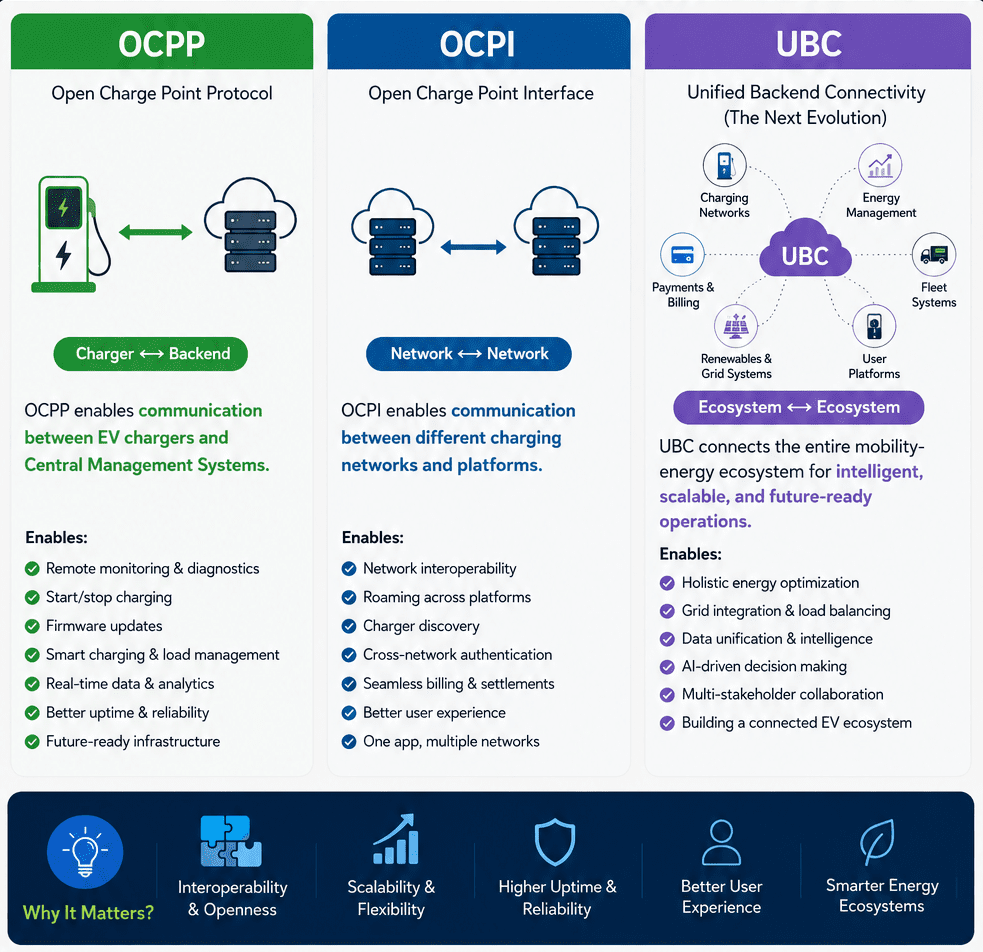
This is where conversations around OCPP, OCPI, and UBC (Unified Bharat eCharge) have suddenly entered the spotlight.
But here’s the catch:
Most discussions frame them as competing standards.
They are not.
The Fragmentation Problem in India’s EV Charging Ecosystem
India’s public charging infrastructure is growing rapidly.
But interoperability has not kept pace.
Today, a typical EV user may need:
- One app for Tata Power
- Another for Statiq
- Another for ChargeZone
- Another for Ather Grid
- Separate wallets, authentication systems, and booking flows
The result:
- Poor user experience
- Charging anxiety
- Lower charger utilization
- Slower EV adoption
While Europe solved portions of this problem using roaming frameworks like OCPI, India’s market structure is fundamentally different:
- Highly fragmented CPO landscape
- Rapid infrastructure expansion
- Diverse payment ecosystems
- Mixed urban/rural deployment conditions
- Strong push for digital public infrastructure
This created the need for a new orchestration layer built specifically for India.
That layer is UBC (Unified Bharat eCharge).
The Four-Layer EV Charging Stack
Layer 1 (The Hardware Layer)
This is the physical infrastructure:
- Chargers
- Connectors
- CCS2
- Type-2
- Bharat DC-001
- Power electronics
- Communication modules
Without this layer, nothing exists physically.
Layer 2 (The Device Communication Layer (OCPP))
This is where OCPP operates.
OCPP defines how a charger communicates with its backend management system. It is the charger’s operating language.
Typical functions include:
- Start/stop charging
- Authentication
- Meter readings
- Fault reporting
- Firmware updates
- Smart charging
- Load balancing
- Remote diagnostics
Without OCPP, chargers become isolated “dumb boxes.”
Layer 3 (The Network Roaming Layer (OCPI))
This is where OCPI comes in.
OCPI enables:
- Roaming between charging networks
- Cross-network authentication
- Tariff exchange
- Billing settlement
- Session token exchange
It allows:
A user from Network A to charge on Network B.
However, OCPI usually requires bilateral agreements between operators.
That works relatively well in Europe.
It becomes difficult in India’s rapidly expanding multi-operator ecosystem.
Layer 4 (The Consumer Transaction & Discovery Layer (UBC))
This is where UBC sits.
UBC enables:
- Unified charger discovery
- Slot booking
- Consumer authentication
- Payments
- Open access APIs
- Multi-app interoperability
Built on the Beckn Protocol, UBC aims to create:
“One nation, one interoperable EV charging network.”
It is essentially the consumer-facing orchestration layer.
What is OCPP?
Open Charge Point Protocol (OCPP)
OCPP is the global communication standard between:
- EV chargers
- Charging Management Systems (CSMS)
Developed by the Open Charge Alliance, OCPP has become the global charging protocol.
Why OCPP Matters
Without OCPP:
- Chargers become vendor-locked
- Backend interoperability breaks
- Fleet-scale charger management becomes impossible
OCPP is foundational infrastructure.
It does not handle:
- User discovery
- Payments
- Roaming marketplaces
- Consumer apps
And that distinction is critical.
What is OCPI?
Open Charge Point Interface (OCPI)
OCPI is a roaming and interoperability protocol.
It enables communication between:
- Charge Point Operators (CPOs)
- eMobility Service Providers (eMSPs)
Developed by the EVRoaming Foundation, OCPI powers many roaming ecosystems globally.
OCPI Enables
- Cross-network roaming
- Session token exchange
- Tariff sharing
- Charging session records
- Billing settlement
- Location synchronization
Example
A driver using an OEM charging app can charge at another network’s charger because both networks exchange information through OCPI.
The Limitation in India
OCPI typically requires:
- Pairwise integrations
- Bilateral agreements
- API compatibility
- Commercial settlement relationships
In a market with:
- 50+ growing CPOs
- Rapid onboarding
- Highly dynamic infrastructure
This creates enormous operational complexity.
What is UBC (Unified Bharat eCharge)?
UBC is India’s national EV charging interoperability framework built on the Beckn Foundation protocol architecture.
Its vision is simple:
Any EV user should be able to discover, book, and pay at any public charger through any participating app.
UBC is being positioned as:
- A national interoperability layer
- A digital public infrastructure for EV charging
- An open network model similar to UPI
Built on Beckn
Beckn enables decentralized open networks where:
- Buyers
- Sellers
- Service providers
- Platforms
can interact without centralized ownership.
Why UBC is Different
OCPI Solves Roaming. UBC Solves Marketplace Interoperability
That distinction matters enormously.
OCPI Model
- Operator-to-operator
- Contract-heavy
- Bilateral integrations
UBC Model
- Open registry architecture
- Network discoverability
- Protocol-level interoperability
- App-agnostic access
How OCPP, OCPI & UBC Work Together
Here’s what actually happens during a charging session.
Discovery
A user opens:
- Google Maps
- OEM app
- Fleet platform
- Navigation system
UBC helps discover nearby chargers.
Booking
UBC handles:
- Slot reservation
- Tariff visibility
- Session initiation
- User authentication
Roaming & Settlement
If the user belongs to another network:
- OCPI exchanges session tokens
- Billing information flows between operators
Charging Session
OCPP now takes over.
The charger continuously communicates with its CSMS:
- Energy consumption
- Session state
- Faults
- Meter values
- Remote commands
Payment
UBC facilitates:
- Unified payment experience
- UPI integration
- Wallet support
- Transparent pricing
The user never needs to switch apps.
Why This Matters for India
India’s EV market has unique requirements:
- Massive population scale
- Diverse charging operators
- Price-sensitive consumers
- Digital-first transactions
- Rapid urbanization
- Public-private infrastructure mix
A fragmented charging experience can slow EV adoption dramatically.
UBC’s strategic importance lies in:
- Open interoperability
- Faster ecosystem onboarding
- Reduced integration friction
- Better charger utilization
- Improved consumer confidence
For India, interoperability is not just convenience.
It is an infrastructure strategy.
India’s EV ecosystem is entering a new phase.
The conversation is no longer just about:
- Building more chargers
- Installing hardware
- Expanding coverage
It is now about:
- Interoperability
- Seamless user experience
- Open infrastructure
- Scalable digital ecosystems
OCPP, OCPI, and UBC are not rivals fighting for relevance.
They are different layers of the same architecture.
- OCPP powers the charger
- OCPI enables roaming
- UBC unifies the consumer experience
And together, they could define the next generation of India’s EV infrastructure.